
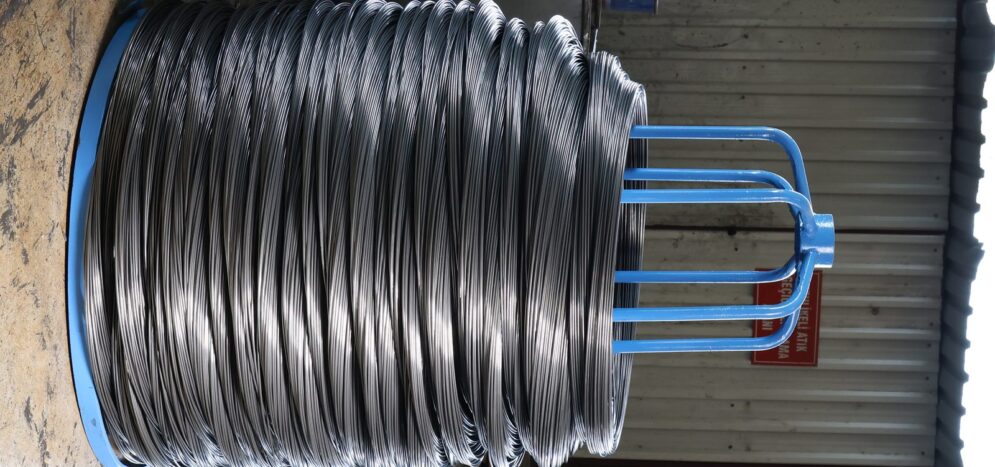
When a steel wire must bend, coil, form, or deep-draw without cracking, engineers reach for annealed steel wire. Annealing is a controlled heat treatment that softens cold-worked steel, relieves internal stress, and restores ductility — turning a hard, springy coil into a formable, predictable material. This guide explains how the material is produced, the practical difference between full-anneal and inter-anneal, and how procurement and quality teams can specify the right grade with confidence.
What annealed steel wire actually is
Every time steel is drawn down through a die, it work-hardens: tensile strength climbs and elongation falls. That is ideal for a spring, but a problem when the wire has to be shaped into a mesh, a fastener blank, or a tightly wound component. Annealing reverses that hardening. The wire is heated to a target temperature, held, and cooled under controlled conditions so the grain structure recrystallises and the internal stresses locked in by drawing are released.
The result is a softer wire with lower tensile strength, higher elongation, and far better formability. At OSSO Wire we supply annealed wire in Ø1.00–12.00 mm to DIN EN 10016 and TS 2348, in both full-annealed and inter-annealed conditions, with mechanical properties matched to how the wire will be worked downstream.
Full-anneal vs inter-anneal
The two terms describe how far the softening is taken and where it sits in the process. Choosing between them is really a choice about how soft the finished wire needs to be.
Full annealing
Full annealing takes the steel through a complete recrystallisation so the wire reaches its softest, most ductile state. Tensile strength is at its lowest and elongation at its highest. This is the condition you want when the wire faces severe deformation — deep drawing, tight bends, heavy heading, or forming operations where any residual hardness would cause splits or tool wear. Fully annealed wire is the go-to for demanding cold-forming and where maximum workability matters more than surface hardness.
Inter-annealing (process annealing)
Inter-annealing, also called process annealing, is a partial softening applied between drawing passes or as a final light treatment. It relieves stress and restores enough ductility for the next forming step without taking the wire all the way to its softest state. That leaves the wire with more tensile strength than a full anneal but still comfortably formable. It is the efficient choice when a component needs moderate forming while retaining some strength, or when the wire will be drawn further after treatment.
A quick side-by-side comparison:
- Full-anneal — lowest tensile strength, highest elongation; best for severe forming, deep drawing and tight bends.
- Inter-anneal (process anneal) — partial softening between passes; moderate strength retained, good ductility, efficient for staged forming.
- Diameter range at OSSO — Ø1.00–12.00 mm for both conditions.
- Standards — DIN EN 10016 and TS 2348, with EN 10204 3.1 certification on request.
How to specify annealed wire
A clear specification prevents rework and rejected lots. When you send an enquiry, the most useful details to state are:
- Grade: typically low-carbon SAE 1006, 1008 or 1010 for good formability.
- Diameter and tolerance: the finished wire size and the band you can accept.
- Anneal condition: full-anneal or inter-anneal, and any target tensile range or elongation.
- Surface: bright or as-annealed, and whether the wire will be coated or plated later.
- Coil or spool format: weight, inner diameter and packaging for your handling equipment.
If you are unsure which condition suits your operation, describe the downstream process — the forming, welding or drawing step tells us how soft the wire has to be. You can review the full range on the OSSO Wire products page, and our team will confirm the grade and mechanical targets before production. Every heat is lot-traceable, so certified properties follow the material through to delivery.
Where annealed wire is used
Because it forms cleanly and welds predictably, annealed steel wire shows up across a wide range of manufacturing. Common applications include construction mesh and reinforcement, fasteners and cold-headed parts, furniture and wireware, white-goods and appliance components, agricultural and fencing products, and general fabrication where wire must be bent, tied or shaped. In each case the anneal condition is tuned to the severity of the forming step so the wire behaves consistently on the line.
Buying annealed steel wire from Türkiye
OSSO Wire is a family-owned precision wire manufacturer based in Manisa, Türkiye, with more than four decades of wire-drawing experience and a 7,000 m² plant. We export annealed and cold-drawn wire to Europe, the Middle East and Africa, and the Americas, so buyers in the EU and North America can source directly from a single manufacturer rather than through several intermediaries. Lead times are typically two to four weeks, and every shipment can be supplied with EN 10204 3.1 inspection certificates. To move from question to price, just send your specification through our request-a-quote form and you will normally have a response within one business day.
Frequently asked questions
What is the difference between annealed and cold-drawn wire?
Cold-drawn wire is pulled through dies to hit a precise size and higher strength, which also makes it harder and less formable. Annealed steel wire has been heat-treated after drawing to soften it, lower the tensile strength and raise elongation, so it bends and forms without cracking. Many parts start as cold-drawn stock and are then annealed to the required condition.
Which anneal should I choose, full or inter?
Match it to your forming severity. Choose full-anneal for the softest wire when parts undergo deep drawing, tight bends or heavy heading. Choose inter-anneal when you need moderate forming while keeping some strength, or when the wire will be drawn again afterwards. If in doubt, describe the operation and we will recommend the condition.
Can OSSO supply certificates and traceability?
Yes. Our annealed wire is produced to DIN EN 10016 and TS 2348, and we provide EN 10204 3.1 certificates on request. Material is heat- and lot-traceable, so the certified mechanical properties are tied to the exact coils you receive.
Ready to specify your next order? Send us your diameter, grade and anneal condition through the request-a-quote form for a reply within one business day, complete with EN 10204 3.1 certification, or reach the team directly via our contact page. Whether you are forming, welding or drawing, we will help you land on the right annealed wire for the job.