
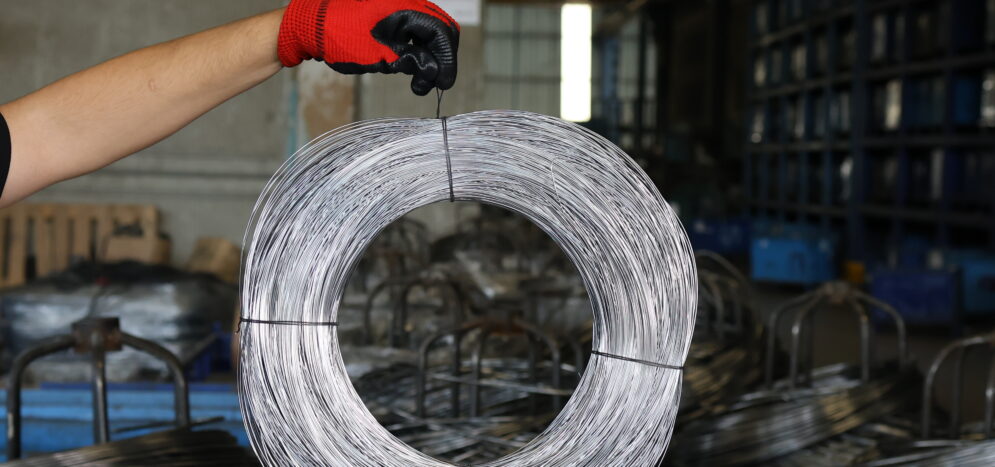
Why fastener production is unforgiving
Cold-heading a fastener puts a wire coil through massive plastic deformation in fractions of a second. Any variance in tensile, any surface flaw, any diameter anomaly shows up as scrap, tool wear, or a header trip. Fastener manufacturers need a wire supply that behaves predictably coil-to-coil — not just batch-to-batch.
Ourcold-drawn wire is built for exactly this discipline.
Steel grades: SAE 1006, 1008, 1010 in practice
SAE 1006/1008/1010 are the low-carbon grades that dominate fastener manufacturing. 1006 is softest, ideal for cold-forming deep-drawn parts. 1008 is the workhorse for general fasteners.
1010 offers slightly higher strength for structural screws. Discuss the exact heat-treatment path with your supplier — the same nominal grade can behave differently depending on drawing schedule and inter-anneal cycles.
Tensile range and scatter — what to specify
For fastener wire, request a tensile range rather than a single value. A typical spec might be 550–650 N/mm² for a mid-strength fastener. But the more important number is scatter within a coil: aim for ±30 N/mm² or tighter across the coil.
Ask your supplier what scatter their line typically holds — if they cannot answer with a number, that is a red flag.
Surface finish for header dies
Bright-drawn wire produces less friction at the header, which extends die life and reduces cosmetic defects on formed parts. Super-bright is worth the premium for high-run parts where die replacement cost is significant. For plating or coating downstream, coating-ready surface is essential.
Packaging: what a fastener mill actually needs
Coil format matters. Fastener mills typically want bobbin winding or rozet coils for direct feeding into headers. Weight per coil should match your feeder capacity — 500 kg is common but discuss the actual constraint.
Loose packaging or damaged ends cause line stops.Send us your coil format when requesting a quote.
Frequently asked questions
Do you supply EN 10204 3.1 inspection certificates by default?
Yes. Every export shipment travels with an EN 10204 3.1 inspection certificate showing chemistry, tensile properties and dimensional data for the actual heat. This is our default, not a paid add-on.
What are your typical lead times for EU and US buyers?
Standard grades ship 2–4 weeks from PO confirmation. Add 5–10 days sea freight to European destinations and 20–25 days to US East Coast under normal conditions. Custom grades or specialty packaging may extend production time.
Can you handle small trial orders before volume commitment?
Yes. We support new customers with sample lots and small trial orders — typically 1–5 tonnes — before ramping to volume. Contact our quote desk to arrange a sample.
What documentation do you provide for EU and US customs clearance?
For EU shipments we provide A.TR movement certificate to support duty-free entry under the EU-Turkey Customs Union. For US shipments we provide certificate of origin and any HS-code-specific documentation required. Discuss requirements with our export desk.
Ready to discuss your steel wire requirement? Request a quote and our technical desk will respond within one business day.