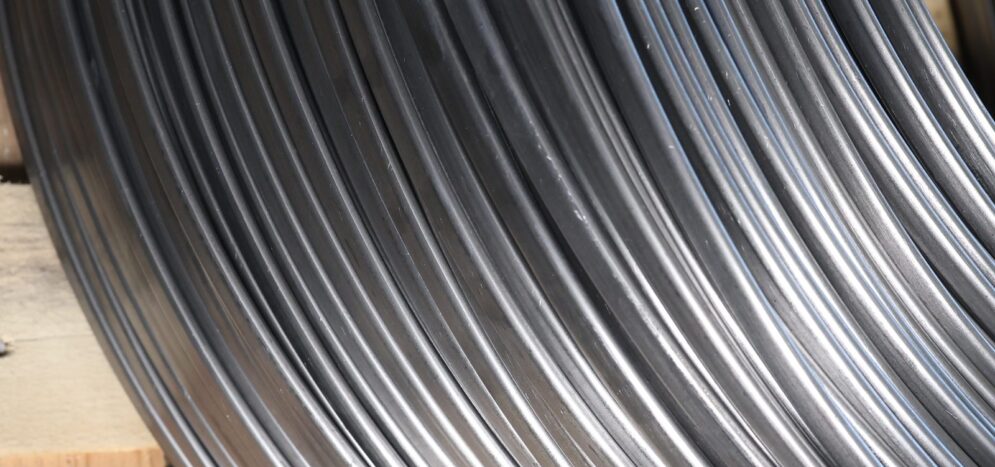
If you draw, form, or fasten steel wire, the quality of your finished product starts long before the drawing die — it starts with the DIN EN 10016 wire rod you feed into the line. This European standard defines the non-alloy steel rod, supplied in coil, that is intended for cold drawing and cold rolling into wire. Getting the specification right is the difference between a clean, predictable process and one plagued by wire breaks, uneven tool wear, and rejected lots. This guide explains what the standard covers, how to read it, and how to specify feedstock with confidence.
What DIN EN 10016 wire rod actually covers
DIN EN 10016 is the European (EN) standard, adopted as a DIN document in Germany, for non-alloy steel wire rod for the production of wire by cold drawing and/or cold rolling. In practice, “wire rod” is the hot-rolled coil — typically 5.5 mm and up — that a wire drawer reduces, step by step, to finished diameters. The standard sets out chemical composition, dimensional tolerances, out-of-roundness, and the quality characteristics that make rod suitable for cold deformation rather than, say, structural use.
It is organised into several parts so that buyers can reference exactly the grade family they need:
- Part 1 — General requirements: tolerances, coil condition, surface quality, and ordering information common to all grades.
- Part 2 — Rod for general-purpose wire: the everyday low-carbon grades used across mesh, fasteners, and formed parts.
- Part 3 — Rod for low-carbon, aluminium-killed steel: cleaner steels for deeper drawing and better surface behaviour.
- Part 4 — Rod for special requirements: tighter controls where the downstream process demands them.
When a purchase order references DIN EN 10016 wire rod together with a grade designation, both the mill and the drawer are working from the same rulebook — which is exactly what a quality engineer wants to see on an incoming inspection sheet.
Why rod quality drives cold-drawing performance
Cold drawing is unforgiving. Every inclusion, decarburised patch, or dimensional swing in the rod is carried forward — and often amplified — as the wire is reduced. Feedstock that conforms to the standard gives you three things that matter on the shop floor:
- Consistent chemistry so mechanical properties are repeatable coil to coil and heat to heat.
- Controlled surface and scale so pickling or mechanical descaling is predictable and die life is protected.
- Tight diameter and ovality so draft schedules stay stable and you avoid mid-run breaks.
For a procurement manager, that translates directly into fewer rejected lots, less unplanned downtime, and a lower total cost of ownership than a “cheaper” but out-of-spec coil ever delivers.
Key characteristics to specify on the order
To turn the standard into a usable purchase specification, put the following on the line item. A short checklist keeps quotes comparable across suppliers:
- Standard and part — e.g. DIN EN 10016-2, plus the grade (common drawing grades map to SAE 1006, 1008, and 1010 chemistries).
- Rod diameter and tolerance — with acceptable ovality.
- Coil weight and inner/outer diameter — matched to your pay-off and accumulator.
- Surface condition — as-rolled, shot-blasted, or pickled and coated.
- Mechanical targets — tensile range for the finished draw, since drawers back-calculate rod properties from the end wire.
- Documentation — inspection certificate type and traceability level.
From wire rod to finished wire
The rod is only the starting point. At OSSO Wire we take conforming rod and cold-draw it to Ø1.00–14.00 mm in bright, super-bright, and black finishes, with tensile strengths from roughly 500 to 1050 N/mm² depending on grade and draft. Where a softer, more formable temper is needed, we full- or inter-anneal to DIN EN 10016-related drawing grades and to TS 2348. The same feedstock discipline feeds our cut-to-length, flat bar, and condenser/bundy-tube wire lines. You can see the full range of finishes and dimensions on our steel wire products page, which lists the grades and tolerances for each family.
Every coil is heat- and lot-traceable, so if a design engineer needs to trace a mechanical result back to a specific melt, the record is there. That traceability, backed by EN 10204 3.1 inspection certificates, is what lets a European or North American quality team accept material without a second qualification cycle.
Sourcing DIN EN 10016 wire rod from Türkiye
For buyers in Europe and the Americas, working with a Türkiye-based manufacturer combines short shipping routes into the EU with competitive lead times — typically 2–4 weeks — and direct technical dialogue in clear international English. OSSO Wire has drawn wire for more than four decades from its plant in Manisa, exporting across Europe, the Middle East and Africa, and the Americas. Because we draw to European standards and issue 3.1 certificates as standard, your incoming inspection process stays exactly the same as with a domestic mill — only the landed cost and flexibility improve.
Frequently asked questions
Is DIN EN 10016 the same as EN 10016?
Yes. EN 10016 is the harmonised European standard; DIN EN 10016 is its adoption in the German (DIN) system. The technical requirements are identical, so a coil ordered to either reference meets the same rules for chemistry, tolerances, and surface quality.
What diameters and grades can OSSO supply?
We cold-draw finished wire from Ø1.00 to 14.00 mm using common drawing chemistries (SAE 1006/1008/1010), in bright, super-bright, and black finishes, plus annealed, cut-to-length, flat bar, and coat-ready condenser wire. Tell us the finished spec and we will confirm the right feedstock and process.
Can you provide material certificates for audit?
Yes — we issue inspection certificates to EN 10204 3.1, with full heat and lot traceability, so your quality and R&D teams can document conformity without re-testing.
Ready to specify with confidence? Send us your grade, diameter, finish, and volume and request a quote — we typically respond within one business day, with EN 10204 3.1 certificates included. For technical questions on matching DIN EN 10016 wire rod to your process, contact the OSSO Wire team and speak directly with the people who draw the wire.