
Starting with wire rod
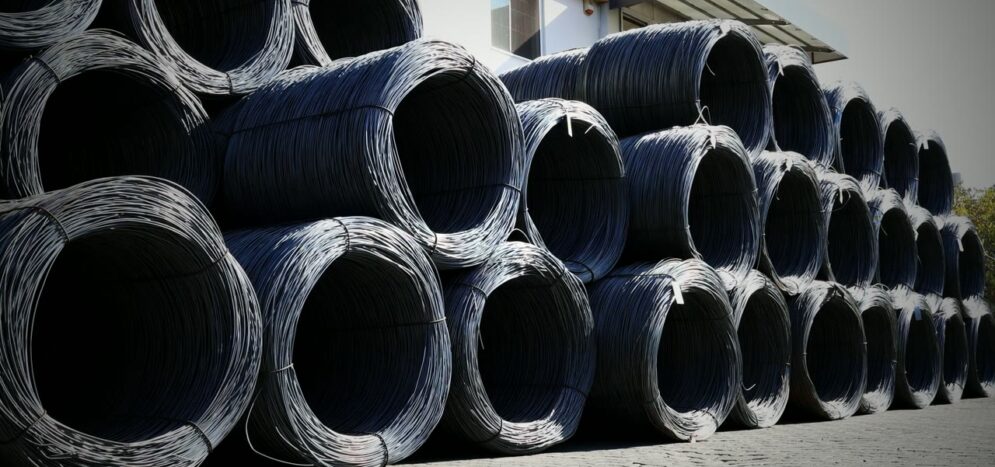
Every steel wire coil starts as wire rod — hot-rolled steel typically Ø5.5–14.0 mm delivered in coils of 1–2 tonnes. Wire rod comes from mini-mills who melt scrap and low-carbon iron in electric arc furnaces, then hot-roll the billets into rod. The chemistry of the rod (its exact carbon, manganese, sulphur, phosphorus content) sets the ceiling on what the drawn wire can become.
Serious wire producers work from a small list of qualified rod mills.
Cold drawing: the core process
Cold drawing pulls wire rod through a series of tungsten-carbide dies of decreasing diameter. Each pass reduces cross-section and increases tensile strength through cold work. A typical cold-drawing schedule includes 3–7 passes depending on the diameter reduction.
The drawing bench applies significant force and the wire must be lubricated at each die. Ourcold-drawn line handles Ø1.00–14.00 mm.
Annealing when the wire needs to be soft
Cold drawing hardens wire. When the customer needs soft wire — for tying, deep-draw forming, or coating pre-treatment — the drawn wire is annealed. Annealing heats the wire in a controlled atmosphere furnace to reset the metallurgy: grain structure recrystallises, hardness drops, ductility rises.
Full-anneal cycles produce soft wire; inter-anneal cycles produce medium-hard wire.
Testing and inspection
Finished coils are tested for chemistry (spot check against the mill certificate), tensile strength, diameter and surface. Every heat generates a paper trail. That paper trail eventually becomes the EN 10204 3.1 inspection certificate that ships with the wire — see ourcertifications page.
Packaging and dispatch
Wire is packaged in the format the customer needs — baskets, bobbins, rozet coils, spools, cut-to-length crates. Every package carries a tag with heat number, lot number and production date. Dispatch is coordinated with the customer’s freight forwarder or with OSSO’s export desk.
Typical lead time from PO to dispatch is 2–4 weeks.
Frequently asked questions
Do you supply EN 10204 3.1 inspection certificates by default?
Yes. Every export shipment travels with an EN 10204 3.1 inspection certificate showing chemistry, tensile properties and dimensional data for the actual heat. This is our default, not a paid add-on.
What are your typical lead times for EU and US buyers?
Standard grades ship 2–4 weeks from PO confirmation. Add 5–10 days sea freight to European destinations and 20–25 days to US East Coast under normal conditions. Custom grades or specialty packaging may extend production time.
Can you handle small trial orders before volume commitment?
Yes. We support new customers with sample lots and small trial orders — typically 1–5 tonnes — before ramping to volume. Contact our quote desk to arrange a sample.
What documentation do you provide for EU and US customs clearance?
For EU shipments we provide A.TR movement certificate to support duty-free entry under the EU-Turkey Customs Union. For US shipments we provide certificate of origin and any HS-code-specific documentation required. Discuss requirements with our export desk.
Ready to discuss your steel wire requirement? Request a quote and our technical desk will respond within one business day.