
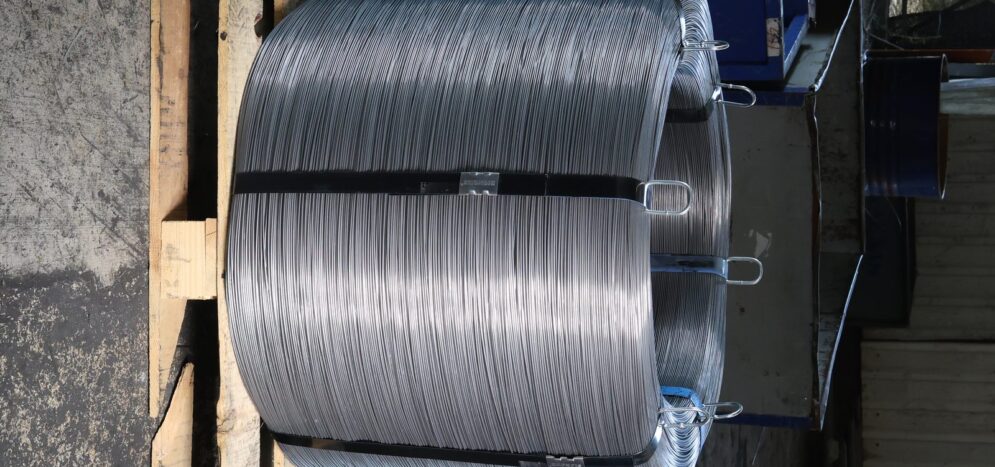
When a coil of wire lands on your factory floor, the nominal diameter printed on the tag is only half the story. What decides how the material behaves is steel wire diameter tolerance: how tightly the actual cross-section holds to that nominal value along every metre of the coil. For procurement managers, quality engineers, and design engineers in Europe and North America, that tolerance band quietly determines whether springs coil consistently, welds run clean, and automated feeders keep running instead of jamming.
What steel wire diameter tolerance actually means
Diameter tolerance is the permitted deviation between the diameter you order and the diameter you receive. It is usually written as a symmetrical band around the nominal size, for example a 3.00 mm wire specified at ±0.02 mm may measure anywhere from 2.98 to 3.02 mm and still conform. Tighter bands cost more to hold but remove variation from every process that follows.
Two properties travel alongside the headline number and matter just as much:
- Ovality — the difference between the largest and smallest diameter at a single cross-section. A wire can sit inside its diameter band yet still be slightly oval, which upsets tooling that expects a true circle.
- Consistency along the coil — a wire that drifts from the low end of the band to the high end over a few hundred metres behaves very differently from one held steady, even though both technically pass.
Why steel wire diameter tolerance matters downstream
The cost of a loose tolerance is rarely paid at goods-in. It shows up later, in the processes that assume the wire is exactly what the drawing says. A wider-than-needed band on steel wire diameter tolerance ripples through the line in predictable ways:
- Spring making: spring rate scales with the fourth power of wire diameter, so a small diameter shift produces a disproportionate change in load and free length — a common cause of out-of-spec springs.
- Cold heading and fasteners: heads form unevenly and die wear accelerates when incoming diameter and ovality wander.
- Welding wire: inconsistent diameter disrupts wire feed speed and arc stability, showing up as spatter and porosity.
- Fine and coated wire: for condenser and bundy-tube applications, an even diameter is what lets a coating sit uniformly and a tube seal reliably.
- Automated handling: feeders, straighteners, and mesh-welding lines are set once and expected to run; diameter drift means constant re-adjustment and scrap.
In each case the wire that passed a loose inspection still costs money in downtime, rework, and yield. Buying a tighter, more consistent tolerance is often cheaper than absorbing that variation.
The standards that define the tolerance band
Rather than negotiating a number from scratch, most buyers anchor the requirement to a recognised standard and then tighten it if the application demands. The specifications OSSO Wire works to give a practical reference point:
- TS EN 10218 — dimensions and tolerances for steel wire, the usual basis for cold-drawn product.
- DIN EN 10016 — rod and drawn wire for cold-heading and cold-extrusion applications.
- TS 2348 — a reference for annealed low-carbon wire.
- EN 10204 3.1 — not a dimensional standard but the inspection certificate that reports actual measured values against your specification, signed by the manufacturer’s quality function.
The right approach is to name the standard, state the nominal diameter, and add a tighter tolerance only where the downstream process genuinely needs it. You can review the full dimensional ranges on the OSSO Wire product range, and see the documentation available on the certifications and documents page.
How a wire drawer actually holds the band
Tolerance is earned in the drawing process, not measured in at the end. Wire is pulled through a sequence of dies, each reducing the diameter a controlled amount, so die quality and die maintenance are the primary levers. Polished, well-maintained dies and correct lubrication keep the surface true and the diameter steady; worn dies open the band and introduce ovality.
Around that sit the disciplines that keep a coil consistent end to end: stable drawing speed, controlled tension, monitoring of the incoming rod, and regular in-process gauging rather than a single check at the end. With more than 40 years of wire-drawing experience and heat- and lot-traceable production, OSSO Wire treats these controls as routine. Traceability matters too: if a downstream problem appears, tying a coil back to its heat and lot turns guesswork into a quick root-cause check.
How to specify tolerance when you source wire
Clear specifications get you the right wire the first time and make suppliers easy to compare. When you send an enquiry, state:
- Nominal diameter and the exact tolerance band you need (for example 4.00 mm ±0.03 mm).
- Ovality limit if your tooling is sensitive to roundness.
- Grade and standard — for example SAE 1006/1008/1010 to TS EN 10218.
- Tensile range and finish (bright, super-bright, or black; annealed condition where relevant).
- Certification — request an EN 10204 3.1 certificate so measured values arrive with the wire.
For buyers in Europe and the Americas, a Turkiye-based manufacturer that exports across these regions offers a practical middle ground: responsive, with in-house drawing that keeps tolerance and paperwork under one roof. Typical lead times run two to four weeks, and diameters from roughly 1.00 to 14.00 mm are covered depending on product.
Frequently asked questions
What is a typical diameter tolerance for cold-drawn steel wire?
It depends on diameter and standard, but cold-drawn wire is commonly held to a symmetrical band on the order of a few hundredths of a millimetre, tightening as the wire gets finer. The most reliable approach is to specify the standard (such as TS EN 10218) plus any tighter band your process needs, and confirm the achievable tolerance with the manufacturer for your exact diameter.
How is diameter tolerance verified and documented?
Diameter is checked in-process and at final inspection using calibrated micrometers or laser gauges, and the measured results can be reported on an EN 10204 3.1 inspection certificate. Combined with heat and lot traceability, this lets you tie any coil back to its production record.
Can I get a tighter tolerance than the standard allows?
Often yes. Tighter bands are achievable with well-maintained dies and closer process control, though they can affect price and lead time. Share your downstream requirement and we will confirm what is realistic for your grade and diameter.
Need wire held to a specific diameter tolerance? Request a quote and receive a response within one business day, complete with EN 10204 3.1 certification, or contact the OSSO Wire team to talk through your grade, tolerance, and delivery to Europe or the Americas.