
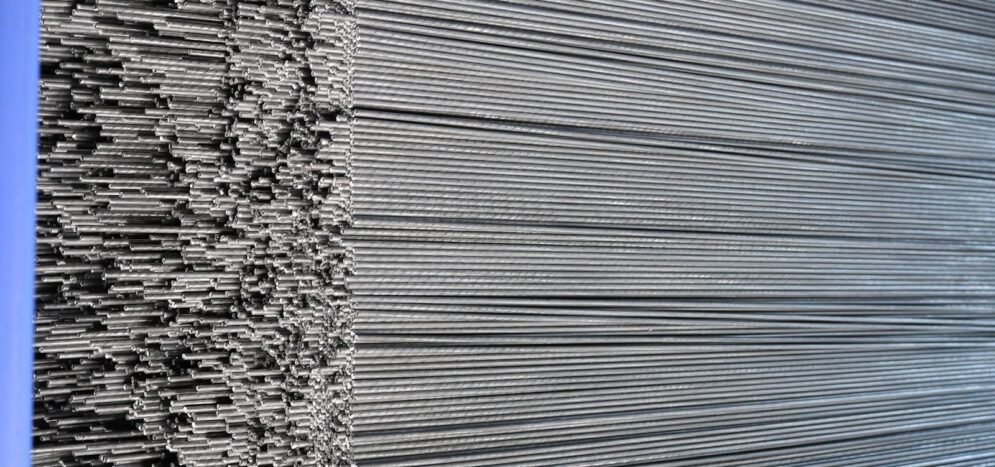
Specifying the right steel wire tensile strength is one of the most consequential decisions a procurement manager or design engineer makes. The tensile band you choose determines whether a spring holds its load, a mesh panel passes inspection, or a fastener forms without cracking, and whether the material reaches your line on time. This guide explains what the 500–1050 N/mm² range means in practice and how to match it to your application with confidence.
What steel wire tensile strength actually measures
Tensile strength is the maximum stress a wire withstands before it fractures under a pulling load, reported in newtons per square millimetre (N/mm², equivalent to MPa). A 900 N/mm² wire, for example, resists roughly 900 newtons of force for every square millimetre of cross-section before breaking. It is not the same as yield strength, the point at which the wire deforms permanently, but the two move together, and both matter when a part must spring back, hold a shape, or survive forming.
For most buyers the practical question is simpler: a higher tensile figure means a stiffer, stronger, less ductile wire; a lower figure means a softer, more formable one. The skill in specifying is choosing the point on that scale where your part performs without becoming brittle or expensive to process.
The 500–1050 N/mm² range, section by section
OSSO Wire draws cold-drawn wire across the full 500–1050 N/mm² band, so a single supplier can cover soft forming grades and high-strength spring stock. Here is how the range typically breaks down:
- 500–650 N/mm² (soft / low tensile): highly formable wire for deep bending, hooks, wireware and appliance components where shape matters more than load.
- 650–850 N/mm² (medium tensile): the workhorse band for construction mesh, fasteners and general fabrication that must balance strength with formability.
- 850–1050 N/mm² (high tensile): stiffer wire for springs, high-load fasteners and parts that must resist deflection or carry sustained stress.
These bands overlap in practice, and the achievable tensile also depends on diameter and steel grade. Thinner wires drawn from the same rod generally reach higher tensile values because of the greater cold work involved.
How the tensile figure is achieved and controlled
In cold-drawn wire, strength is built through the drawing process itself. Each pass through a die reduces the diameter and work-hardens the steel, raising tensile strength in a predictable way. Starting chemistry matters too: low-carbon grades such as SAE 1006, 1008 and 1010 set the baseline, and the reduction schedule tunes the final figure. OSSO produces this wire to TS EN 10218 in bright, super-bright and black finishes.
When an application needs the opposite, a soft and ductile wire, annealing relieves the stresses that drawing introduces. Full or inter-annealed wire to DIN EN 10016 / TS 2348 brings tensile strength down and restores formability for bending, weaving and coating operations. Choosing between cold-drawn and annealed stock is often the first fork in a specification. You can review the full steel wire product range and diameter capabilities to see which process fits your part.
Matching the right band to your application
The correct band depends on how the part is loaded and formed:
- Springs and clips need high tensile and good elastic recovery, usually the upper end of the range.
- Fasteners and cold-formed parts need enough strength to perform but enough ductility to form without cracking, typically the medium band.
- Mesh, fencing and welded assemblies balance weld integrity with load capacity, often mid-range.
- Wireware, hooks and appliance parts favour formability, so lower tensile grades or annealed wire win.
If you are unsure, share the finished-part requirement, the load, the forming operation and any standard you must meet, and let the wire specification follow from it rather than the other way around.
Specifying and verifying tensile strength with your supplier
A tensile figure on a drawing is only as good as the traceability behind it. Ask three things of any wire supplier: can they hold the tensile band consistently across a lot, will they document it, and can they trace it back to the heat? OSSO supplies wire that is heat- and lot-traceable, with inspection certificates to EN 10204 3.1 confirming the mechanical properties you ordered, the evidence your own quality system and customers will ask for.
Geography matters less than it used to. As a Türkiye-based manufacturer shipping to Europe, the Americas, and the Middle East and Africa, OSSO delivers on lead times of roughly two to four weeks, with the certification European and North American buyers expect. When you are ready to lock in a grade, you can request a quote with your tensile and diameter requirements and receive a response within one business day.
Frequently asked questions
What is a typical steel wire tensile strength range for low-carbon wire?
Low-carbon cold-drawn wire commonly falls between 500 and 1050 N/mm². Softer grades near 500–650 N/mm² suit forming and wireware, while high-tensile grades approaching 1050 N/mm² suit springs and high-load parts. The exact figure depends on diameter, steel grade and the drawing schedule.
Can the same wire diameter be supplied at different tensile strengths?
Yes. For a given diameter, tensile strength is adjusted through the drawing reduction and, where a softer temper is needed, through annealing. That is why it is important to state both the diameter and the required tensile band when you order.
How do I verify the tensile strength I received?
Request an EN 10204 3.1 inspection certificate. It documents the measured mechanical properties for your specific lot and, combined with heat and lot traceability, lets you confirm the wire matches your specification before it reaches production.
Ready to specify with confidence? Tell us your diameter, grade and target steel wire tensile strength, and our team will match it to the right cold-drawn or annealed grade. Request a quote for a response within one business day, or contact our team to discuss your application, complete with EN 10204 3.1 certificates and full lot traceability.